
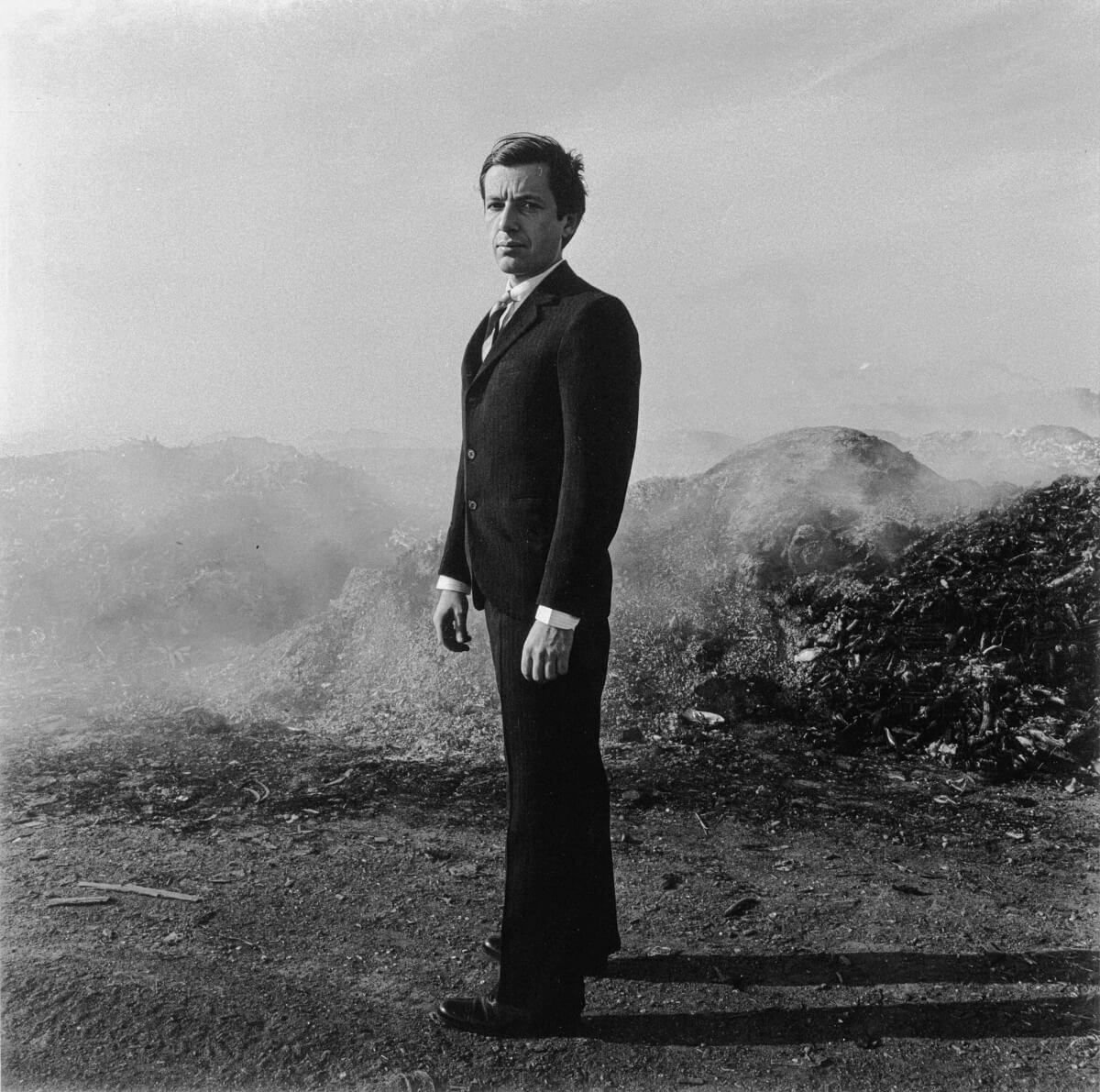

"Hacer visible lo invisible." — Roberto Aizenberg
Roberto Aizenberg (1928 - 1996) is an essential figure in 20th-century Argentine art and, at the same time, an eccentric figure in that narrative due to his unique and distinctive work. Aizenberg defined himself as a surrealist painter, a framework he configured as exclusive for his production and which he fueled with a personal and rigorous mysticism.
He worked with the method of psychic automatism, through which he attempted to capture free thought associations without the regulating intervention of reason. He then undertook a meticulous process of refinement until he reached the essence of the image. His exceptional technique is evident in his handling of color, chiaroscuro, and transparencies.
Various motifs organize and recur throughout his work, among which the tower is the most emblematic, along with the fan, anthropomorphic figures (with spherical or headless heads), and geometric forms that rise above the horizon or float in the void. Aizenberg also explored these geometries in his sculptures, both in metal and marble. The critic Aldo Pellegrini characterized this group of works as belonging to a “metaphysical geometry” that “ceases to be a material sign and becomes a spiritual one.”
A paradigmatic example is the work Father and Son Contemplating the Shadow of a Day (1962), which is part of a series of paintings in which a man and a child gaze out into the silent immensity of the landscape. The globular formations that dominate the lower part of this painting were created using the grattage technique, applying layers of paint to the canvas and scraping the surface with a sharp blade.
The unsettling coexistence of abstraction and figuration that characterizes Aizenberg's work is also present in his drawings and wood sculptures, in which he unfolds images of smoking heads, female legs emerging from cubic structures, and bathers with soft bodies wearing suits with designs resembling cerebral convolutions and sulci. Aizenberg used to say, "I am a time machine," and indeed, his ambition to become a classical painter led him to be one of the most contemporary.
PROJECTS
Group exhibition reconsiders Argentina’s surrealist artistic legacy from the unstable terrain of the contemporary world, displacing the human as its privileged subject and tracing agency across bodies, technologies, ecologies, matter, other forms of life, and invisible forces.