
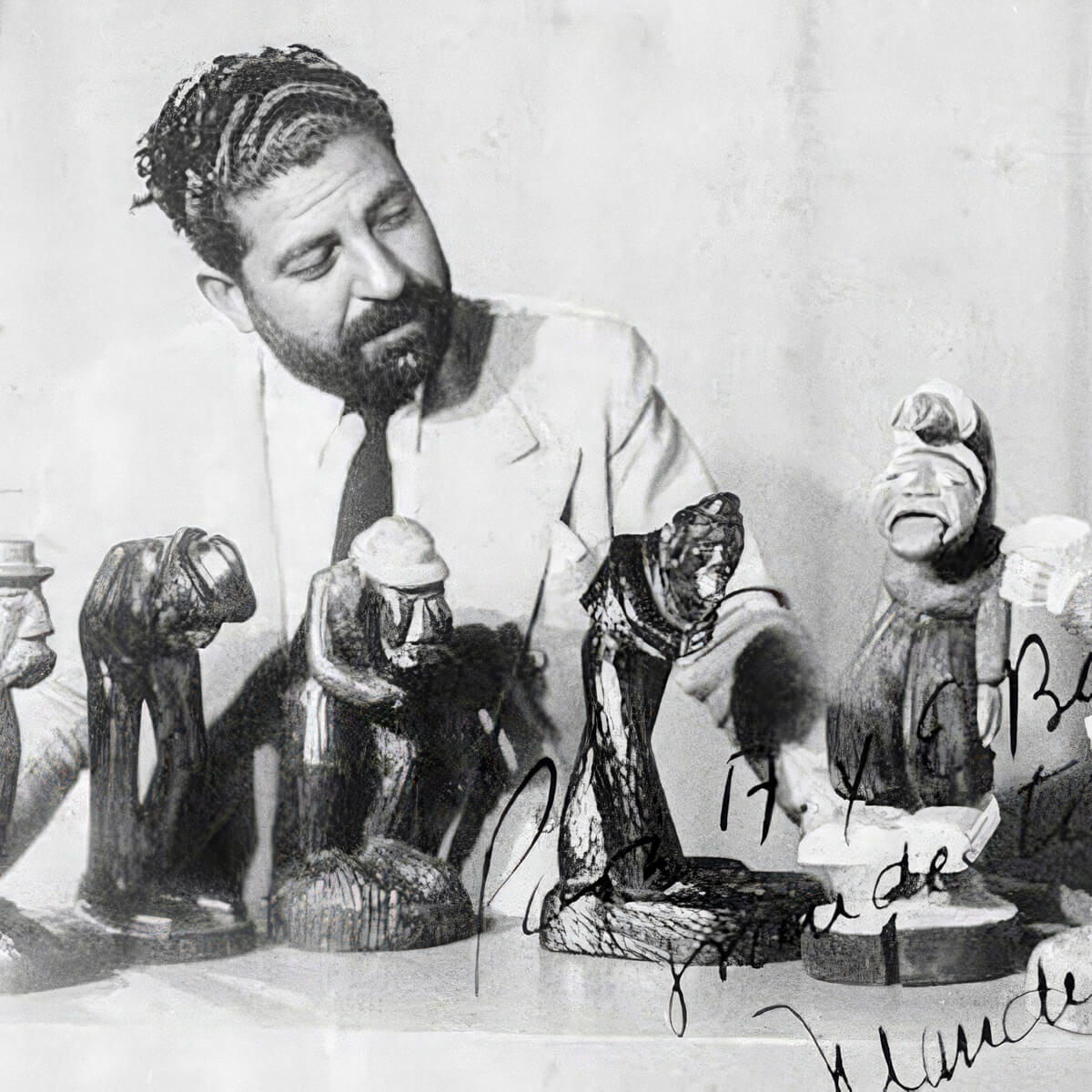

Juan de Dios Mena (1897–1954) was an Argentine self-taught sculptor, woodcarver, and poet, widely regarded as a foundational figure in the country's tradition of popular imagery. He was born in 1897 in Puerto Gaboto, in the province of Santa Fe, into a humble family. Having received only limited formal schooling, he educated himself through reading, oral storytelling, and close observation of nature. Before devoting himself to art, he worked in a variety of occupations, including farm laborer, gendarme, dockworker, and construction worker.
Around 1925, he settled in Chaco, a region he came to consider his own and which inspired much of his artistic production. He began carving wood around 1932, working primarily with curupí and guayaibí. Combining irony with tenderness, he portrayed gauchos, craftsmen, and other figures from the rural world and northern Argentina. He also wrote verse and poetry, which appeared in magazines and newspapers such as Fray Mocho, Nativa, and La Voz del Chaco.
Together with Aldo Boglietti, he became a central figure of El Fogón de los Arrieros, the legendary cultural space in Resistencia, where he was known as “Capataz” (“Foreman”). He died on April 4, 1954, in Rosario, Santa Fe. His legacy endures through collections and museums, including El Fogón de los Arrieros and the Castagnino+macro Museum, and his woodcarvings have been exhibited in cities such as New York, Madrid, Rome, Paris, and London.
Today, Mena's work is represented in major public and private collections across Argentina and remains an important reference point in discussions surrounding identity, folklore, and the relationship between popular culture and modern art.
PROJECTS
Group exhibition reconsiders Argentina’s surrealist artistic legacy from the unstable terrain of the contemporary world, displacing the human as its privileged subject and tracing agency across bodies, technologies, ecologies, matter, other forms of life, and invisible forces.
